A patient sits across from me in my office in West Islip. She has just been told she has a small meningioma near the base of her skull. Her surgeon — that’s me — is recommending a treatment called “stereotactic radiosurgery.” She’s trying to process the words. Finally, she stops me mid-sentence.
“I’m sorry, Doctor. Is this surgery, or is this radiation? Because it sounds like both.”
She’s right to be confused. The name is almost designed to disorient people. Radio plus surgery sounds contradictory. Patients hear “radiation” and think of cancer therapy. They hear “surgery” and picture an operating room, a scalpel, a long recovery. Stereotactic radiosurgery — often shortened to SRS — is neither of those things, exactly. It’s its own category of treatment, and for the right patient with the right problem, it can be one of the most elegant tools in modern neurosurgery.
So let’s clear up the confusion.
What Stereotactic Radiosurgery Actually Is
Here’s the simplest definition I can offer: stereotactic radiosurgery is a way of delivering a very high, very precise dose of radiation to a small target in the brain — without cutting, without a hospital stay, and without general anesthesia for most patients.
The “surgery” in the name refers to the precision and intent of the treatment, not to a scalpel. The goal is surgical — we’re targeting a specific lesion with the intent of destroying it or stopping its growth. The method is radiation. Hundreds of small radiation beams converge from many different angles onto a single point in the brain. Each individual beam is weak enough to pass harmlessly through healthy tissue. Where they all meet, the combined dose is high enough to kill tumor cells [1,2].
It’s a bit like focusing sunlight through a magnifying glass. The light going into the lens is ordinary. At the focal point, it’s intense enough to burn. That’s the basic principle SRS is built on.
The idea was first proposed by a Swedish neurosurgeon named Lars Leksell in 1951, who coined the term radiosurgery and later developed the first dedicated machine — the Gamma Knife — in 1967 [1,3]. More than half a century later, the technology has advanced enormously, but the core idea is the same: concentrate radiation where you want it, and nowhere else.
What the Experience Is Actually Like for a Patient
A lot of patient anxiety about SRS comes from not knowing what to expect on the day of treatment. Here’s a realistic walkthrough.
- You arrive as an outpatient. No hospital admission. No general anesthesia for most procedures.
- Head immobilization is the most involved part of the setup. Depending on the system being used, this might involve a lightweight frame attached to the scalp with pins (numbed with local anesthetic) or a custom-fitted thermoplastic mask. The goal is sub-millimeter accuracy — the head has to stay perfectly still so the radiation converges exactly where the plan says it should.
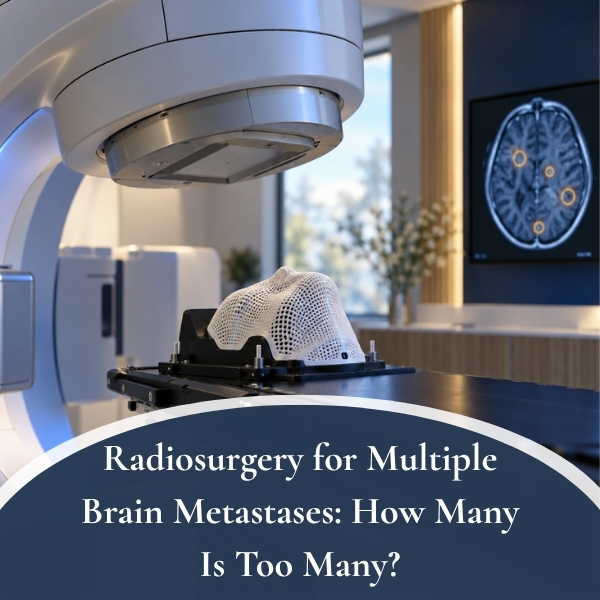
- High-resolution imaging — usually MRI and sometimes CT — is used to map the target. This is where your neurosurgeon, a radiation oncologist, and a medical physicist sit together and build a personalized treatment plan, often for several hours.
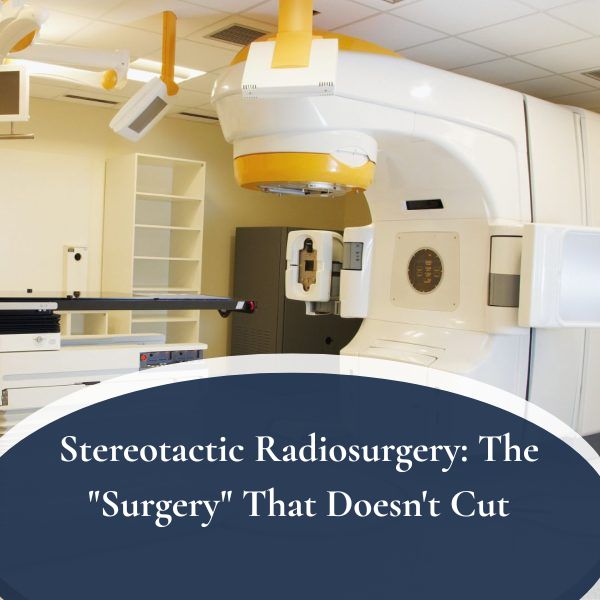
- The treatment itself is uneventful. You lie on a table. The machine rotates around your head. You feel nothing. You hear nothing unusual. There is no heat, no pressure, no sensation of the radiation. Most treatments take somewhere between 30 minutes and a couple of hours, depending on the lesion.
- You go home the same day. Many patients return to normal activity the next morning. There’s no incision to heal, no staples, no surgical recovery in the traditional sense.
The most common reaction I get from patients afterward is some version of “That was it?” Yes. That was it.
What SRS Is Used to Treat
SRS is not a universal solution, and it’s not right for every brain problem. But there are several conditions where it’s either the primary treatment or one of the legitimate first-line options:
- Brain metastases. SRS has become a standard treatment for many patients with metastatic tumors to the brain. Modern professional society guidelines, including those from the American Society for Radiation Oncology, strongly recommend SRS for patients with limited brain metastases and good overall functional status [4]. Critically, using SRS rather than whole-brain radiation helps preserve cognitive function — a difference that has been demonstrated in randomized trials [4,5].
- Small meningiomas. For benign meningiomas that need treatment but are small and in accessible locations, SRS can achieve long-term control rates comparable to surgery, without the risks and recovery of a craniotomy.
- Acoustic neuromas (vestibular schwannomas). For small to moderately sized tumors, SRS is one of three legitimate options — along with observation and microsurgical removal — and has become a preferred choice for many patients because of its non-invasive nature.
- Pituitary tumors. Particularly for residual or recurrent tumors after previous surgery, SRS can be an effective way to control further growth.
- Trigeminal neuralgia. For patients with this notoriously painful condition, SRS targets the trigeminal nerve root and can provide significant relief for many patients who have failed medication or who are not good candidates for more invasive procedures [6].
- Arteriovenous malformations (AVMs) and some other vascular lesions. Selected AVMs can be gradually obliterated over 1 to 3 years following a single SRS session.
Not everyone with these conditions needs SRS, and not everyone who needs treatment needs SRS specifically. The decision always depends on the specifics of the lesion — size, location, growth rate, symptoms — and the patient.
Single Session or a Few Sessions?
One source of confusion: patients often hear that radiation therapy for cancer takes weeks of daily treatments. SRS is different.
Classic stereotactic radiosurgery is a single-session treatment. The entire dose is delivered in one sitting, which is why the precision matters so much. For lesions where a single large dose would be too risky to surrounding structures — larger tumors, or tumors close to critical areas like the optic nerves or brainstem — the total dose can be split across three to five sessions. This is called hypofractionated stereotactic radiosurgery (sometimes abbreviated SRT or fSRS) [1,4].
Whether a given lesion is best treated in one session or a few depends on size, location, and the specific tissue involved. Your surgeon, radiation oncologist, and medical physicist work that out together during treatment planning. From your perspective, the experience is largely the same either way — you just come in on a few separate days.
How SRS Compares to Traditional Brain Surgery
The most important thing to understand is that SRS and craniotomy (open brain surgery) are not competing for the same patients. They’re complementary tools, and the right answer depends on the clinical picture.
SRS tends to be the better option when:
- The lesion is small (typically under about 3 cm for single-fraction treatment)
- The lesion is in a location that would be high-risk to reach surgically
- The patient has medical conditions that make general anesthesia risky
- The primary goal is long-term growth control rather than complete removal
- The lesion is benign, slow-growing, and does not need tissue diagnosis via surgery
Traditional surgery tends to be the better option when:
- The lesion is large and causing mass effect on the brain
- There’s pressure on critical structures that needs to be relieved quickly
- A tissue diagnosis (biopsy) is needed
- The lesion is in a location amenable to safe surgical removal
- The patient has symptoms that won’t respond fast enough to radiation
Often, the two are used in combination. For instance, a large brain metastasis might be surgically removed, and SRS is then used on the surgical cavity to reduce the chance of recurrence, or on other smaller lesions elsewhere. The goal is to pick the right tool for each problem — not to pick one tool and use it for everything.
What SRS Is Not
There are some common misconceptions worth clearing up, because patients often arrive with ideas that don’t match reality:
- It is not “just radiation.” Conventional radiation therapy for cancer typically treats larger areas with many small doses over weeks. SRS is a focused, high-precision, high-dose treatment aimed at a defined target — a fundamentally different approach [1,4].
- It is not painless in the sense of being carefree. Most patients feel nothing during treatment, but the emotional weight of a brain-tumor diagnosis is real. Anxiety is normal. So is fatigue in the days afterward.
- It doesn’t make tumors vanish instantly. This is probably the single most important thing to understand. Unlike surgery, where a tumor is physically removed, SRS works biologically. The radiation damages tumor cells’ ability to divide. Over the following months — sometimes up to a year or two — the tumor stops growing, may shrink, or in some cases gradually disappears. But on the MRI the day after treatment, it will still be there. That’s normal and expected.
- It is not without any risk. Side effects are generally mild and uncommon, but they do exist. The most notable is radiation-induced changes in nearby brain tissue, sometimes called radiation necrosis, which occurs in a small percentage of cases and is usually manageable [4]. Headaches, fatigue, and temporary swelling are more common but typically self-limited.
A Word on the Precision
Much of what makes SRS possible is technology that didn’t exist 40 years ago. Modern systems combine high-resolution MRI, CT, and sometimes angiography into three-dimensional treatment plans that are custom-built for every patient [2,3]. Some systems use a stereotactic frame fixed to the head for sub-millimeter accuracy; others use frameless immobilization with a mask and real-time image guidance.
The underlying principle is the same in every case: deliver the full prescribed dose to the target, and let the dose fall off rapidly at the edges so that surrounding healthy tissue is spared. The precision at the edge — how quickly the dose drops outside the target — is in many ways what separates SRS from conventional radiation therapy.
When I describe this to patients, I sometimes use the analogy of a flashlight versus a laser pointer. Conventional radiation is a flashlight: broad, diffuse, illuminates everything nearby. SRS is a laser pointer: narrow, directed, affects only what you aim at.
How to Know If SRS Might Be an Option for You
If you’ve been told you have a brain lesion — a tumor, an AVM, a vestibular schwannoma, or something else — it’s worth asking about SRS as part of the conversation. Questions that tend to help:
- Is my lesion a candidate for stereotactic radiosurgery, or is surgery (or observation) a better option?
- What’s the expected long-term control rate for my specific lesion with SRS?
- What side effects are possible, and how likely are they in my case?
- Will this require a single session or multiple sessions?
- Who would be on the treatment team — neurosurgeon, radiation oncologist, medical physicist?
A good SRS program involves all three specialists working together. If the answer to the last question is vague, that’s worth noting. SRS done well is a team endeavor.
The Bottom Line
Stereotactic radiosurgery is one of the most interesting developments in modern neurosurgery: a way of treating certain brain lesions with surgical intent but without the scalpel, the hospital stay, or the recovery of a traditional operation. It’s not a replacement for open surgery — both have their place, and the right answer depends on the patient and the problem. But for the right patient with the right lesion, SRS can be remarkable: you walk in, you walk out, and in the weeks and months that follow, your problem quietly resolves.
If you’ve been told you might be a candidate for stereotactic radiosurgery, or if you’ve been recommended brain surgery and want to know whether SRS could be an alternative, our offices in West Islip and Smithtown are here to help. As with all neurosurgical decisions, the right treatment is the one that matches your specific situation — and worth a careful, honest conversation before anyone turns on a machine.
Dr. Symeon Missios is a board-certified neurosurgeon practicing on Long Island, with expertise in brain and spine surgery, including stereotactic radiosurgery. To schedule a consultation or second opinion, request an appointment or call (631) 422-5371 or toll-free (888) 737-5427.
References
- Leksell L. The stereotactic method and radiosurgery of the brain. Acta Chirurgica Scandinavica. 1951;102(4):316–319.
- Rich KM, Desai R. Therapeutic role of Gamma Knife stereotactic radiosurgery in neuro-oncology. Missouri Medicine. 2019;116(6):488–492. PMC7023953
- Leksell L. Stereotactic radiosurgery. Journal of Neurology, Neurosurgery, and Psychiatry. 1983;46(9):797–803. doi:10.1136/jnnp.46.9.797
- Gondi V, Bauman G, Bradfield L, et al. Radiation therapy for brain metastases: an ASTRO clinical practice guideline. Practical Radiation Oncology. 2022;12(4):265–282. doi:10.1016/j.prro.2022.02.003
- Brown PD, Jaeckle K, Ballman KV, et al. Effect of radiosurgery alone versus radiosurgery with whole brain radiation therapy on cognitive function in patients with 1 to 3 brain metastases: a randomized clinical trial. JAMA. 2016;316(4):401–409. doi:10.1001/jama.2016.9839
- Tuleasca C, Régis J, Sahgal A, et al. Stereotactic radiosurgery for trigeminal neuralgia: a systematic review. Journal of Neurosurgery. 2019;130(3):733–757. doi:10.3171/2017.9.JNS17545
By Symeon Missios, MD — Long Island Brain & Spine