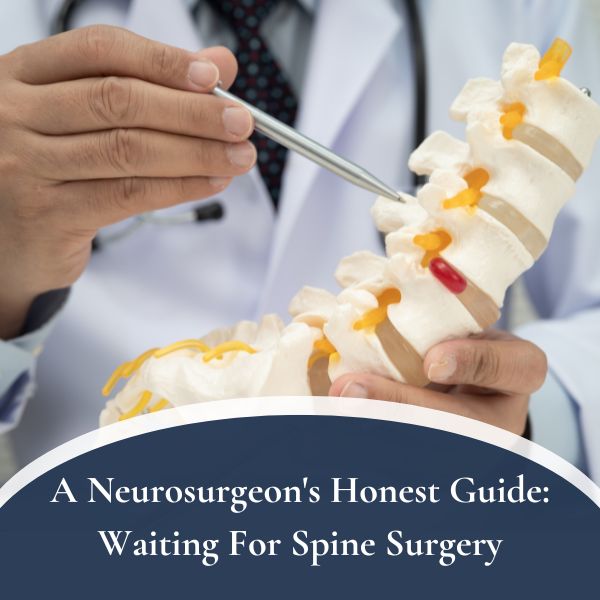
A Neurosurgeon’s Honest Guide on When to Wait
Imagine you’re sitting in a waiting room, MRI images in hand, trying to process what the doctor just told you. There’s a herniated disc at L4-L5. Or stenosis at three levels. Or degeneration that looks, in the radiologist’s own words, “severe.” The word “surgery” has been mentioned. And now, somewhere in the quiet panic of that moment, you’re wondering: do I actually need this?
As a neurosurgeon who sees patients across Long Island — in West Islip, Smithtown, and at The Cancer Institute at Good Samaritan — I have this conversation almost every day. And here’s something that might surprise you: a significant portion of the patients who walk into my office have been told they need spine surgery when they don’t. At least, not yet. Sometimes not ever.
This isn’t a criticism of other physicians. Spine surgery, when it’s the right answer, is transformative. I’ve operated on patients who couldn’t walk to their mailbox before surgery and were back on the golf course six weeks later. But surgery isn’t always the answer, and one of the most important parts of my job is knowing when to tell a patient to wait.
So let’s talk honestly about it.
The Two Spine Problems That Send People to My Office Most Often
Most of the spine consultations I do fall into two broad categories, and the “do I need surgery?” question plays out differently in each one.
1. Disc Herniation and Sciatica
A herniated disc happens when the soft inner core of a spinal disc pushes through a tear in the tougher outer layer. When the herniated material presses on a nerve root, patients typically feel sharp pain radiating down a leg (sciatica) or down an arm, depending on whether the disc is in the lower back or neck. There can be numbness, tingling, or weakness in the affected limb.
The pain is real. The imaging often looks dramatic. And the natural assumption — one that a lot of patients arrive with — is that something this intense surely requires a surgical fix.
Here’s what the data actually tells us: the vast majority of lumbar disc herniations improve on their own within 6 to 12 weeks. The body reabsorbs the herniated material. Inflammation calms down. The nerve has more room. Studies following patients over time have shown that non-surgical treatment produces outcomes comparable to surgery at the one- and two-year mark for most people — though surgery does offer faster pain relief in the early months for selected patients.
If you’re curious about distinguishing a disc-related nerve problem from more general back pain, I wrote about this in detail in “Back Pain vs. Pinched Nerve: How to Tell the Difference.”
2. Spinal Stenosis and Degenerative Disc Disease
These two are cousins. Both are wear-and-tear conditions that show up more frequently as we age. Spinal stenosis is a narrowing of the spinal canal that can compress the nerves inside. Degenerative disc disease is the gradual loss of disc height, flexibility, and hydration over the decades — essentially, the spine aging the way every other part of the body ages.
Symptoms vary. Stenosis often causes leg pain or heaviness when walking that improves with sitting or leaning forward (patients sometimes notice they can push a grocery cart farther than they can walk unsupported). Degenerative disc disease more commonly shows up as chronic, aching lower back pain, sometimes with radiating symptoms.
Here’s the part that catches many patients off guard: almost everyone over the age of 50 has some degree of degenerative change on their MRI. Studies of pain-free volunteers — people who have zero back complaints — routinely find disc bulges, facet arthritis, and signs of degeneration in 60% or more of those over 50. Which means the words on your MRI report and the pain you’re experiencing may or may not be closely related.
Learning more about these conditions in detail may help. I have separate pages covering spinal stenosis, degenerative disc disease, and back and leg pain.
The Uncomfortable Truth About Spine MRIs
One of the most important things I try to help patients understand in consultation is this: your MRI is a picture, not a diagnosis.
An MRI shows structure. It does not show pain. Two patients with nearly identical images — the same disc bulge, the same level of stenosis, the same degenerative changes — can have completely different experiences. One is bedridden. The other is running half-marathons.
This matters for a simple reason: the decision to operate should be driven by the whole patient — the pain, the functional limitation, the response to conservative treatment, the neurological exam, the trajectory of symptoms over time — with the MRI as supporting evidence. When an MRI alone drives the surgical recommendation, something has gone wrong in the decision-making process.
When I Tell Patients to Wait
Here are the scenarios where, in most cases, I recommend holding off on surgery:
- The pain is severe but recent. If the symptoms started within the last several weeks and the patient hasn’t completed a meaningful trial of conservative treatment, surgery is almost never the first move.
- Imaging findings don’t match the symptoms. When the MRI shows a herniated disc on one side but the pain is on the other, or when stenosis is mild and the pain is out of proportion, something else may be driving the symptoms.
- No meaningful neurological deficit. If strength is normal, reflexes are intact, and sensation is preserved, there’s usually time to let conservative treatment work.
- Conservative treatment hasn’t been tried properly. A few sessions of physical therapy at the wrong intensity, a single round of oral steroids, or a brief medication trial doesn’t count as “failed conservative care.”
- The symptoms are improving, even slowly. A trajectory of improvement — even gradual — is often worth preserving by not operating.
- The patient has medical conditions that significantly raise surgical risk. Sometimes the safer answer is a longer trial of non-surgical treatment, especially when the problem isn’t an emergency.
In these situations, patience isn’t giving up. It’s giving your body a chance to do what it’s remarkably good at: healing itself.
What a Real Conservative Treatment Plan Looks Like
Patients often tell me they’ve “tried everything.” When I dig in, what they’ve actually tried is two weeks of Motrin and one physical therapy visit that mostly involved heating pads. That isn’t a trial of conservative care — that’s a prelude to one.
A genuine non-surgical treatment plan for disc herniation, stenosis, or degenerative disc disease usually includes:
- Structured physical therapy, 6 to 12 weeks. Not casual stretching — a progressive program led by a therapist who understands spine conditions, focused on core strength, posture, flexibility, and nerve mobility.
- Targeted medication management. This can include anti-inflammatories, short courses of oral steroids, nerve-pain medications (gabapentin, pregabalin), and, in some cases, muscle relaxants.
- Epidural steroid injections, when appropriate. For radicular (nerve-root) pain from a herniated disc or stenosis, an image-guided epidural injection can provide meaningful relief and often helps the body recover while symptoms are quieter.
- Activity modification without deconditioning. Rest for a few days is fine. Weeks of bed rest is harmful. The goal is to avoid what provokes symptoms while staying as active as tolerated.
- Weight optimization and lifestyle factors. Every extra pound adds load to the lumbar spine. Smoking impairs disc healing. Sleep affects pain perception.
- Time. The single most underrated treatment in spine care.
If none of that is working after a legitimate trial — typically three months or more — then it may be time to seriously discuss surgical options. But that discussion should happen after the effort, not in place of it.
When I Tell Patients: Yes, It’s Time
To be clear: I am a spine surgeon. I operate often, and I believe deeply in the procedures I perform. The point of this article isn’t that surgery is always wrong. It’s that the timing and indication have to be right.
Here are the situations where I don’t counsel waiting — where surgery moves from “maybe” to “now”:
- Progressive or severe neurological weakness. A foot that won’t lift properly, a grip that’s suddenly much weaker, a leg that buckles — these are signals that the nerve is being injured in a way that waiting can worsen.
- Cauda equina syndrome. Sudden loss of bladder or bowel control, combined with saddle-area numbness or profound leg weakness, is a surgical emergency. Go to the emergency room — don’t wait for a clinic appointment.
- Intractable pain despite a complete conservative trial. When three months of appropriate treatment haven’t moved the needle, and the pain is preventing sleep, work, or basic function, the balance shifts.
- Severe, clearly symptomatic stenosis. When a patient can walk only a few steps before leg pain stops them, when the limitation is profound and the imaging matches the story, delaying surgery usually isn’t kindness.
- Instability or deformity that’s worsening. Some spine problems are mechanical and progressive; in those, surgery isn’t just about pain, it’s about preventing further deterioration.
The goal is never to operate, and it’s never to avoid operating. The goal is to do the right thing for the patient in front of me.
A Note on Second Opinions
Second opinions are not insulting to the first surgeon. A good surgeon expects them, sometimes even recommends them. If you’ve been told you need spine surgery and something doesn’t feel right — whether it’s the pace of the recommendation, the extent of the proposed procedure, or simply a gut sense that the conversation was too fast — get a second opinion.
Bring the following to that appointment:
- The actual MRI images on a CD or USB drive, not just the written report
- A detailed list of what conservative treatments you’ve tried and for how long
- A clear accounting of your symptoms — severity, location, triggers, trajectory
- A written list of your goals, whatever they are: walk without pain, return to work, sleep through the night, play with grandchildren
The surgeon who takes these things seriously, answers your questions without rushing, and gives you an honest assessment of both surgical and non-surgical options is the surgeon worth listening to — whether that person is me or someone else.
If you’d like to know more about when a spine consultation is appropriate in the first place, I covered this in “Back Pain: When to See a Neurosurgeon vs. a Chiropractor or Physical Therapist.”
The Bottom Line
Most back pain gets better without surgery. Most sciatica gets better without surgery. Most degenerative changes on an MRI don’t require surgery, even when they look alarming on the report. When spine surgery is the right answer, it can be profoundly life-changing — but the path to a good surgical outcome starts with an honest conversation about whether surgery is actually the best next step.
If you’re facing that conversation right now, take a breath. Ask questions. Try the boring, slow, unglamorous things first. And if you’d like a second opinion from a neurosurgeon who will give you a straight answer — including, sometimes, the answer “you don’t need surgery” — our offices in West Islip and Smithtown are here to help.
Because the right surgery, at the right time, for the right patient, is the kind of medicine worth practicing. And so is the decision not to operate.
Dr. Symeon Missios is a board-certified neurosurgeon practicing on Long Island, with expertise in brain and spine surgery. To schedule a consultation or second opinion, request an appointment or call (631) 422-5371 or toll-free (888) 737-5427.
By Symeon Missios, MD — Long Island Brain & Spine