By Symeon Missios, MD — Long Island Brain & Spine
A woman in her late fifties sits down in my office and puts a folder on the desk between us. Inside is an MRI report, a surgical plan, and a printout she made at two in the morning.
She has been told she needs a three-level lumbar fusion. Her back has hurt for four years. The report uses phrases like degenerative disc disease, facet arthropathy, and disc desiccation at multiple levels, and she has read every one of them more times than is good for anybody.
She wants to know whether the operation is really necessary. Then she asks the second question, almost apologetically, and it is the one that tells me what she actually came for.
“Would you tell me if it wasn’t?”
Yes. I would.
Spinal fusion has a complicated reputation, and some of it is deserved. It has been performed on people who did not need it, and the result in those cases can be a patient who is worse off than before, with chronic pain and hardware and a diagnosis nobody wants: failed back surgery syndrome. I take that seriously.
But the correction to overuse is not blanket refusal. It is better selection. For the right patient, a lumbar fusion is one of the more satisfying operations I perform, and that includes some patients with degenerative disc disease and no instability at all. Here is how I think about who is who.
What a Fusion Actually Is
A spinal fusion is not a repair. Nothing gets restored to its original condition, and no disc is replaced with a new one.
A fusion permanently joins two or more vertebrae into a single block of bone. Screws, rods, and a spacer hold those bones still, bone graft is packed between them, and over the following months the body grows new bone bridging the gap. The hardware is not the cure. The hardware is the cast. The cure, if it works, is the new bone, and a fusion that never solidifies has failed regardless of how good the X-ray looked on day one.
This is different from a decompression. A microdiscectomy removes a fragment of disc pressing on a nerve. A laminectomy removes bone to widen a narrowed canal. Both relieve pressure, and neither requires a fusion.
A decompression takes pressure off a nerve. A fusion takes away motion. Understanding which of those your problem actually needs is the whole decision.
Two Different Reasons to Fuse
I want to correct a misconception up front, because it appears constantly in patient education material and it is not accurate.
A fusion does not require instability to be appropriate. Instability is one good reason to fuse. It is not the only one.
The first reason is mechanical instability: one vertebra moving relative to another in a way it should not, usually demonstrated on standing X-rays taken bending forward and backward. When a segment is genuinely unstable, holding it still is straightforward logic.
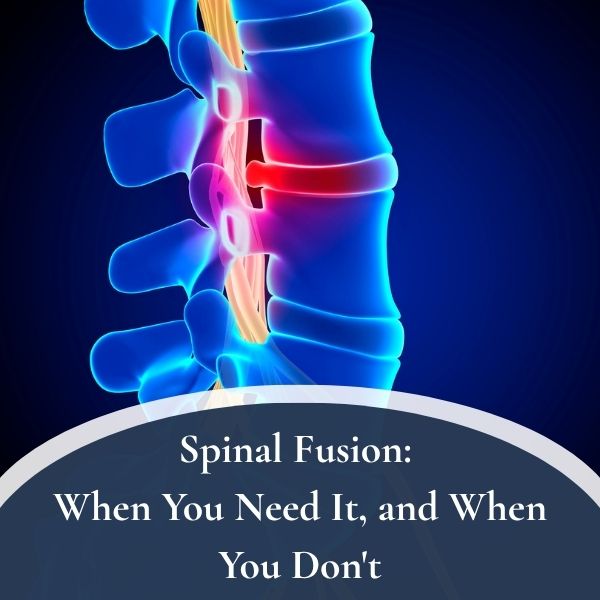
The second reason is painful motion at a segment that is stable but badly degenerated. A disc that has collapsed to nothing, with inflammatory changes in the bone above and below it, can hurt every time it is loaded, even though nothing is sliding. In that situation, motion itself is the pain generator, and eliminating that motion, while restoring some of the lost height, is a rational operation.
Both are legitimate. The second one is where careful patient selection matters most, and where the field earned its bad reputation by being careless.
Where Fusion Genuinely Earns Its Place
These are the situations where the case for fusion is strong:
- Spondylolisthesis with instability. One vertebra has slipped forward on another and moves on flexion-extension films. Combined with stenosis and leg symptoms, the evidence for surgery here is good, and this is where the argument for adding fusion is strongest [1].
- Advanced single-level or two-level disc collapse with endplate changes and mechanical axial pain. The discogenic patient described in the next section. No instability required.
- Deformity. Scoliosis or kyphosis causing pain, nerve compression, or progressive imbalance. Correcting alignment requires holding the correction.
- Fracture. An unstable traumatic injury where the bony architecture can no longer safely carry load.
- Tumor. Cancer that has destroyed enough of a vertebral body to threaten collapse or cord compression.
- Infection. Discitis or osteomyelitis with bone destruction and instability.
- Instability created by the decompression itself. Sometimes relieving nerve compression requires removing so much bone and facet joint that the segment will not be stable afterward. Fusing it is then part of the same decision.
- Revision for a fusion that never solidified, or for a segment that has become unstable next to a previous one.
Fusion Without Instability: The Collapsed, Painful Disc
This is the group I want to describe carefully, because it is the group most often dismissed by the blanket claim that fusion never helps back pain.
There is a specific pattern I look for. Not vague back pain with an aging MRI, but a recognizable clinical picture:
- Complete or near-complete loss of disc height at one level, or at most two. A disc space that has essentially collapsed, not merely darkened on MRI.
- Endplate changes in the bone above and below the disc. These are the marrow signal changes first described by Modic and colleagues in 1988, and they are visible on routine MRI [2]. Their presence is associated with chronic low back pain in a way that ordinary disc desiccation is not [3].
- Axial mechanical pain that matches the level. Pain in the low back, worse with standing, sitting upright, and loading the spine, and meaningfully relieved by lying down. Mechanical pain behaves like a structural problem, because it is one.
- Pain that is the dominant complaint, rather than leg pain, and that has persisted through a genuine course of structured nonoperative care over months, not weeks.
- A limited number of levels, so the operation is targeted rather than a broad campaign against a spine that simply looks old.
When those features line up, an interbody fusion is a reasonable and often a good operation. Placing a structural spacer into the collapsed disc space restores height, indirectly opens the nerve exit tunnels that collapsed along with the disc, and eliminates motion at the segment that has been generating pain. I have seen this work well, and I offer it.
The professional guidelines on selecting patients for lumbar fusion make the same essential point: imaging findings should be interpreted alongside the clinical picture, and the value of any single test lies in whether it identifies a pain source that matches the patient’s actual symptoms [4]. The MRI narrows the question. The patient answers it.
What I will not do is extend that reasoning across four levels of ordinary age-related change in someone whose pain does not behave mechanically. That is exactly how good operations get a bad name.
Why This Operation Earned a Bad Reputation
The skepticism about fusion for back pain did not come from nowhere, and it is worth understanding what the trials actually showed.
A Swedish randomized trial in 2001 compared fusion against nonsurgical treatment for chronic low back pain and favored surgery, though the comparison group received relatively unstructured care [5]. When later trials compared fusion against genuinely structured rehabilitation with cognitive therapy, that advantage largely disappeared. A Norwegian trial found no significant difference between instrumented fusion and a structured rehabilitation program [6], and the British MRC spine stabilisation trial found only a small difference in one disability score, of doubtful clinical significance, at the cost of an operation and its complications [7].
Those results are real and I do not wave them away. But it matters what those trials enrolled: broad populations of chronic low back pain with degenerative discs, selected largely on pain and imaging degeneration rather than on the narrower pattern I described above. A trial that mixes well-selected discogenic patients in with patients whose pain is diffuse, non-mechanical, or driven by factors surgery cannot touch will produce a diluted average, and that is roughly what happened.
So the fair conclusion is not that fusion fails for back pain. It is that fusion fails as a default response to back pain. Those are different claims, and the difference between them is patient selection.
There is also a vocabulary problem worth naming. “Degenerative disc disease” sounds like a diagnosis, but on most reports it simply describes a spine that has been in use for several decades. Bulges, desiccation, and mild height loss are extremely common in adults with no pain whatsoever, which is why I keep returning to the same principle in my writing on imaging and back pain: the scan describes the spine, but it does not by itself explain the symptom. A collapsed disc with endplate changes and concordant mechanical pain is a much more specific finding than the phrase on the report.
Stenosis: Where Reasonable Surgeons Disagree
Lumbar spinal stenosis deserves its own mention, because here the evidence is genuinely mixed rather than one-sided, and patients deserve to know that.
In April 2016 the New England Journal of Medicine published two randomized trials on this question in the same issue, and they did not agree. The Swedish trial found no additional clinical benefit from adding fusion to decompression at two years or five, with longer operating time and higher cost [8]. The American trial, studying the narrower group of stenosis with a grade I degenerative slip, found a modest advantage for adding fusion at four years, though with more blood loss and longer hospitalization, while the laminectomy-alone group had more reoperations [9].
My reading of the two together is that adding fusion in stenosis benefits some patients, modestly where it does, and largely depending on whether a true unstable slip is present. It is a judgment that should be explained to you in terms of your own films, not a reflex.
One broader trend is worth stating honestly. Over one studied decade, the rate of surgery for lumbar stenosis in older adults stayed roughly flat, but the use of complex multi-level fusion rose sharply, with higher complication rates and substantially higher costs [10]. Complexity grew faster than the evidence supporting it.
The Long-Term Trade-Off Worth Understanding
A fused segment does not move. The motion it used to contribute does not disappear; it transfers to the levels above and below, which now absorb more load than they were built for.
Over years, this accelerates wear at the neighboring levels. In one long-term series, the estimated probability of needing another operation at an adjacent level was roughly 16 percent at five years and about 36 percent at ten [11]. That comes from a single center and should not be treated as a universal prediction, but the direction is not controversial.
This is the strongest argument for fusing as few levels as the problem genuinely requires. It is not an argument against fusing at all. A well-chosen single-level fusion that resolves years of mechanical pain is a good trade. A four-level fusion for diffuse degeneration in a patient who was never a good candidate is a poor one, and the adjacent-level math makes it worse. The three-level plan in my patient’s folder deserved that scrutiny, and did not survive it.
Questions Worth Asking Before You Agree to a Fusion
You do not need a medical background to ask these, and any surgeon should be able to answer them directly:
- What exactly are you fusing, at which levels, and why those levels specifically?
- What is the rationale: instability, or a painful degenerated segment? If instability, what test demonstrated it? If discogenic pain, what identifies that disc as the source?
- Is my dominant problem back pain or leg pain, and which does this operation treat better?
- Does my pain behave mechanically, and does the plan match that pattern?
- Would a decompression alone address the nerve compression, and what does adding fusion accomplish beyond that?
- What happens if I wait six months and complete a genuinely structured rehabilitation program first?
- Realistically, what improvement should I expect, in which symptom, and what percentage of patients like me get it?
- What is the plan if the bone does not fuse?
- How does this change my chances of needing another operation in ten years?
If the answers are specific, mechanical, and tied to your own imaging and examination, that is a good sign. If they rest mainly on how degenerated the MRI looks, get another opinion. That is not an insult to your surgeon. It is ordinary diligence, and the same instinct I described in my guide to when spine surgery can wait.
The Bottom Line
Spinal fusion is the right operation for instability, deformity, fracture, tumor, infection, and for the specific case of a slipped vertebra compressing nerves. It is also a reasonable operation for a well-selected patient with a collapsed disc, endplate changes, and mechanical axial pain that has not responded to real nonoperative care, and no instability is required for that patient to be a candidate.
Where it goes wrong is as a default answer to back pain in a spine that merely looks worn, across more levels than the problem justifies, in a patient whose pain does not behave mechanically. That is the version that produced the trials people quote against fusion, and the patients who never got better.
The right question is not whether your MRI looks degenerated, because almost everyone’s does past a certain age. The question is whether a specific segment can be identified as the source of your specific pain, and whether the proposed operation is aimed precisely at it. When the answer is nerve compression alone, a smaller operation will usually do. When the answer is a single collapsed and inflamed segment driving mechanical pain, a fusion may be exactly right.
If you have been told you need a spinal fusion and you would like a second look at the reasoning, our offices in West Islip and Smithtown are available for consultation and second opinions. Please bring your imaging, including the disc itself and not only the written report, along with any flexion and extension X-rays that have been taken. For comprehensive brain and spine care across the practice, you can also reach Long Island Brain & Spine at longislandbrainandspine.com. If you develop new leg weakness, numbness in the saddle area, or loss of bowel or bladder control, do not wait for an appointment. Go to the nearest emergency department.
Dr. Symeon Missios is a board-certified neurosurgeon practicing on Long Island, with expertise in brain and spine surgery, cerebrovascular disease, and stereotactic radiosurgery. To schedule a consultation or second opinion, request an appointment or call (631) 422-5371 or toll-free (888) 737-5427.
References
- Weinstein JN, Lurie JD, Tosteson TD, et al. Surgical versus nonsurgical treatment for lumbar degenerative spondylolisthesis. N Engl J Med. 2007;356(22):2257–2270. PubMed: 17538085
- Modic MT, Steinberg PM, Ross JS, Masaryk TJ, Carter JR. Degenerative disk disease: assessment of changes in vertebral body marrow with MR imaging. Radiology. 1988;166(1 Pt 1):193–199. PubMed: 3336678
- Hopayian K, Raslan E, Soliman S. The association of modic changes and chronic low back pain: A systematic review. J Orthop. 2023;35:99–106. PubMed: 36438174
- Resnick DK, Choudhri TF, Dailey AT, et al. Guidelines for the performance of fusion procedures for degenerative disease of the lumbar spine. Part 6: magnetic resonance imaging and discography for patient selection for lumbar fusion. J Neurosurg Spine. 2005;2(6):662–669. PubMed: 16028734
- Fritzell P, Hägg O, Wessberg P, Nordwall A. 2001 Volvo Award Winner in Clinical Studies: Lumbar fusion versus nonsurgical treatment for chronic low back pain: a multicenter randomized controlled trial from the Swedish Lumbar Spine Study Group. Spine (Phila Pa 1976). 2001;26(23):2521–2532. PubMed: 11725230
- Brox JI, Sørensen R, Friis A, et al. Randomized clinical trial of lumbar instrumented fusion and cognitive intervention and exercises in patients with chronic low back pain and disc degeneration. Spine (Phila Pa 1976). 2003;28(17):1913–1921. PubMed: 12973134
- Fairbank J, Frost H, Wilson-MacDonald J, et al. Randomised controlled trial to compare surgical stabilisation of the lumbar spine with an intensive rehabilitation programme for patients with chronic low back pain: the MRC spine stabilisation trial. BMJ. 2005;330(7502):1233. PubMed: 15911537
- Försth P, Ólafsson G, Carlsson T, et al. A Randomized, Controlled Trial of Fusion Surgery for Lumbar Spinal Stenosis. N Engl J Med. 2016;374(15):1413–1423. PubMed: 27074066
- Ghogawala Z, Dziura J, Butler WE, et al. Laminectomy plus Fusion versus Laminectomy Alone for Lumbar Spondylolisthesis. N Engl J Med. 2016;374(15):1424–1434. PubMed: 27074067
- Deyo RA, Mirza SK, Martin BI, Kreuter W, Goodman DC, Jarvik JG. Trends, major medical complications, and charges associated with surgery for lumbar spinal stenosis in older adults. JAMA. 2010;303(13):1259–1265. PubMed: 20371784
- Ghiselli G, Wang JC, Bhatia NN, Hsu WK, Dawson EG. Adjacent segment degeneration in the lumbar spine. J Bone Joint Surg Am. 2004;86(7):1497–1503. PubMed: 15252099