Stroke Specialist Serving Bay Shore, NY
Dr. Symeon Missios, MD, FAANS, is a board-certified neurosurgeon with fellowship training in endovascular neurosurgery. Bay Shore patients can see him in nearby West Islip for minimally invasive treatment of stroke, brain aneurysms, and vascular malformations, along with open cerebrovascular surgery and second opinions.
If you think someone is having a stroke, call 911 right away.
A Stroke Specialist Near Bay Shore
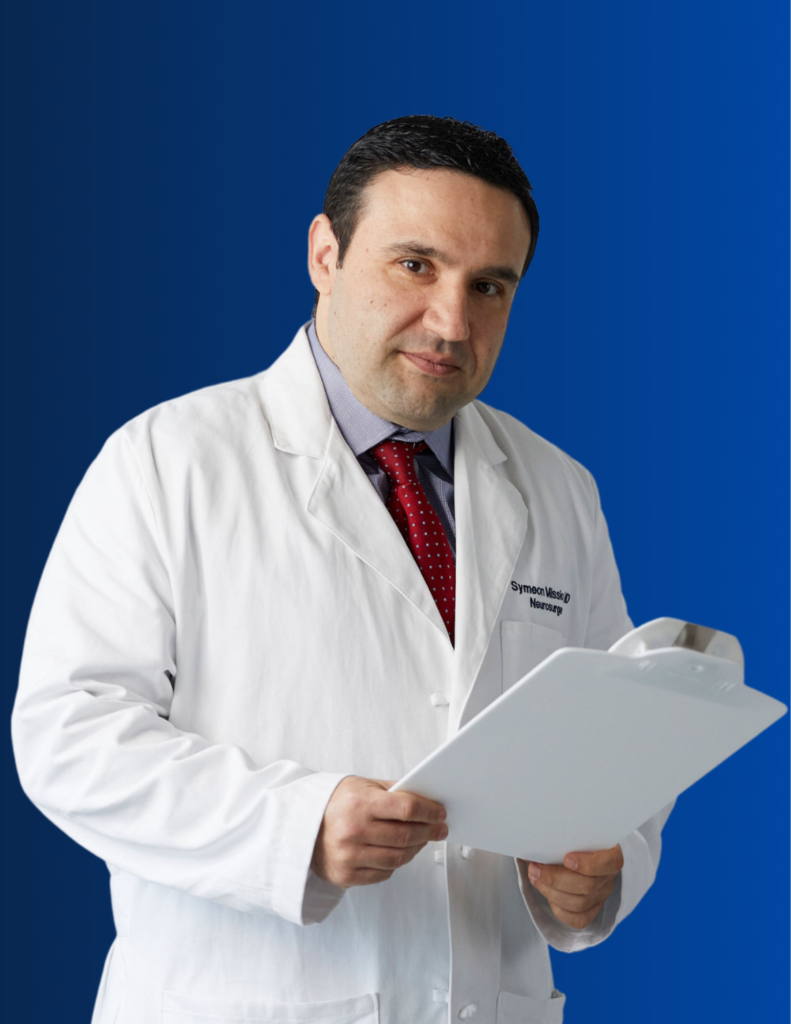
Dr. Missios completed a fellowship in Endovascular Neurosurgery and Neurovascular Critical Care at Thomas Jefferson University, in addition to a fellowship in Neurosurgical Oncology and Stereotactic Radiosurgery at Cleveland Clinic. Because he is trained in both open cerebrovascular surgery and endovascular techniques, treatment decisions are based on what is best for each patient, not on what a single technique can offer.
Comprehensive Stroke Center
Affiliated with the only Joint Commission Certified Comprehensive Stroke Center on Long Island’s South Shore.
Board-Certified Neurosurgeon
Certified by the American Board of Neurological Surgery since 2014 and a Fellow of the American Association of Neurological Surgeons (FAANS).
Dr. Missios has co-authored more than 80 peer-reviewed publications, including published work on cerebrovascular disease.
Closest Office to Bay Shore
Long Island Brain & Spine, 380 Montauk Highway, West Islip, NY 11795
Stroke and Cerebrovascular Conditions We Treat
Endovascular neurosurgery treats diseases of the blood vessels of the brain and spinal cord from inside the vessels themselves, guided by real-time X-ray imaging.
Acute Ischemic Stroke
A clot blocking a large artery in the brain. Mechanical thrombectomy physically removes the clot and can dramatically improve outcomes when performed promptly.
- Mechanical Thrombectomy
- Stent Retrievers
- Aspiration Catheters
Brain Aneurysms
Weakened, ballooned artery walls in the brain. Treatment depends on the aneurysm’s size, shape, neck width, and location, and some can be safely observed with imaging.
- Coil Embolization
- Flow-Diverting Stents
- Open Surgical Clipping
AVMs and dAVFs
Abnormal tangles or connections between arteries and veins. Embolization can shrink or cure these lesions, and some are best treated with open surgery.
- Liquid Embolic Agents
- Embolization
- Open Surgery
Carotid and Vertebral Artery Disease
Narrowing or dissection of the carotid or vertebral arteries in the neck, which can be treated with stenting in selected patients.
- Carotid Stenting
- Embolic Protection Devices
- Diagnostic Angiography
Cerebral Vasospasm
Spasms of the brain’s arteries that can follow a subarachnoid hemorrhage, treated from inside the vessel.
- Angioplasty
- Intra-Arterial Medication
Diagnostic Cerebral Angiography
The gold-standard imaging study for the brain’s blood vessels, giving a detailed view of vascular anatomy to guide treatment decisions.
- Detailed Vascular Imaging
- Treatment Planning
- Light Sedation for Some Studies
Mechanical Thrombectomy for Acute Stroke
When a clot blocks a large artery in the brain, stent retrievers or aspiration catheters can physically remove it. Performed promptly, mechanical thrombectomy can dramatically improve outcomes.
- Every Minute Matters
Faster treatment is always better. Eligibility depends on imaging findings and the time since symptoms began. - Treatment Up to 24 Hours
Many patients can be treated up to 24 hours after stroke onset when imaging shows brain tissue that can still be saved. - No Open Surgery
Catheters are guided through the blood vessels from a small puncture at the wrist or groin, without opening the skull.
What to Expect With Endovascular Treatment
Most endovascular procedures avoid an open craniotomy and involve shorter hospital stays than open surgery.
- Before
Pre-procedure planning includes detailed imaging (CTA, MRA, or diagnostic angiography), medical optimization, and a thorough discussion of risks and benefits. - During
Procedures are performed under general anesthesia in a neuro-angiography suite. Catheters are guided to the target vessel under continuous X-ray guidance. - After
Patients are observed overnight in a neuro ICU or step-down unit. Many elective patients go home within one to two days and return to normal activity within one to two weeks.
Endovascular or Open Surgery?
Endovascular treatment generally offers a less invasive option with faster recovery and is the standard of care for many aneurysms, acute large-vessel strokes, and dural fistulas. Open microsurgical clipping remains the better choice for certain aneurysms, such as those with wide necks, complex branch anatomy, or large size, and for AVMs and hematomas where direct removal is needed. Dr. Missios’s practice spans both.
- Endovascular Neurosurgery Fellowship
Thomas Jefferson University, including Neurovascular Critical Care. - Neurosurgical Oncology and Stereotactic Radiosurgery Fellowship
Cleveland Clinic. - Neurological Surgery Residency
Dartmouth-Hitchcock University Hospital. - Board Certification
American Board of Neurological Surgery since 2014.
Why Bay Shore Patients Choose Dr. Missios
- Open and Endovascular Options in One Practice
- Coordinated Stroke Care Across Long Island Hospitals
- Peer-Reviewed Expertise in Cerebrovascular Disease
- Second Opinions Welcomed
- English, Spanish, and Greek Spoken
- 24-Hour On-Call Service
“My husband has made a full recovery after suffering a major stroke. The rapid, skillful and compassionate response by you and your team is a gift for which my family and I are forever grateful.”
Linda & Robert M.
Read patient testimonials
Stroke Care FAQs for Bay Shore Patients
Where can Bay Shore patients see Dr. Missios?
Dr. Missios sees patients at Long Island Brain & Spine, 380 Montauk Highway, West Islip, NY 11795, and at the Cancer Institute at Good Samaritan, 111 Beach Drive, West Islip, NY 11795. He also has an office at the St. Catherine of Siena Medical Building, 48 Route 25A, Suite 302, Smithtown, NY 11787.
What is mechanical thrombectomy and is there a time limit?
Mechanical thrombectomy is the physical removal of a large-vessel clot in acute ischemic stroke using a catheter-based device. Eligibility depends on imaging findings and the time since symptom onset. Many patients can be treated up to 24 hours after stroke onset when imaging shows salvageable brain tissue. Faster is always better.
Is endovascular treatment safer than open brain surgery?
Endovascular treatment is less invasive and generally has a shorter recovery, but every procedure has its own risk profile. For some aneurysms and conditions, endovascular treatment offers the best risk-benefit ratio, and for others open surgery does. The right choice is specific to each patient and discussed in detail at consultation.
Can an unruptured aneurysm always be treated endovascularly?
Not always. The decision depends on aneurysm size, shape, neck width, location, and the involvement of nearby branches. Some aneurysms are better suited to open clipping, and some can be safely observed with serial imaging.
How long is recovery after an endovascular procedure?
Many elective endovascular procedures involve a one- to two-day hospital stay, with return to light activity within a week and to most normal activities within two to three weeks. Recovery from stroke thrombectomy depends on the stroke itself rather than the procedure.
Will I be awake during my procedure?
Most cerebral endovascular procedures are performed under general anesthesia for comfort and precision. Some diagnostic angiograms are performed with light sedation. Your anesthesia plan is discussed before the procedure.
Do you accept insurance?
Yes. We accept most major insurance plans.
Talk it through with Dr. Missios.
New diagnosis, second opinion or referral: we will get you seen quickly and walk you through each step.
380 Montauk Highway, West Islip, NY 11795Directions →
48 Route 25A, Suite 302, Smithtown, NY 11787Directions →
111 Beach Drive, West Islip, NY 11795Directions →