Stroke Specialist in West Islip
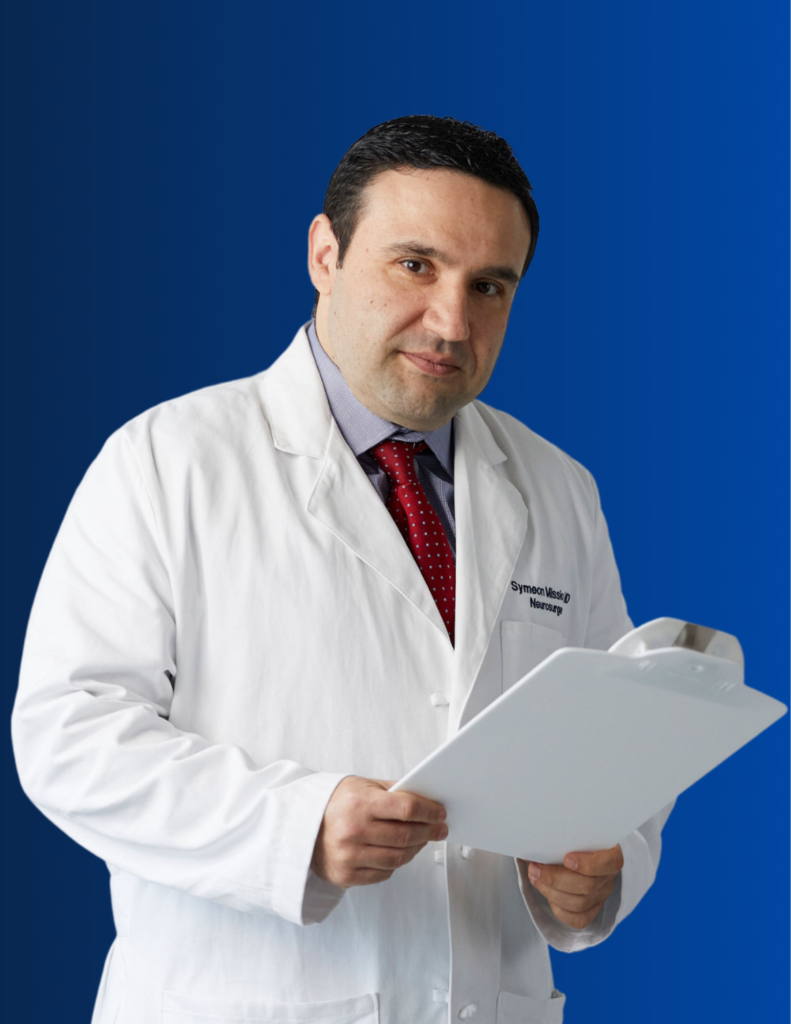
Dr. Symeon Missios is a board-certified neurosurgeon with fellowship training in endovascular neurosurgery and neurovascular critical care. He treats stroke and brain aneurysms at the only Joint Commission Certified Comprehensive Stroke Center on Long Island’s South Shore.
Having Stroke Symptoms Right Now? Call 911.
Stroke treatment is time-dependent. Do not call our office, do not drive yourself, and do not wait to see whether symptoms pass. Emergency medical services can begin treatment en route and route you to a comprehensive stroke center. Use the guide below and note the time symptoms started.
- B — Balance
Sudden dizziness, loss of balance, or trouble walking. - E — Eyes
Sudden vision loss or double vision in one or both eyes. - F — Face
One side of the face droops or feels numb. Ask the person to smile. - A — Arms
One arm drifts downward when both are raised, or feels weak or numb. - S — Speech
Slurred speech, trouble speaking, or difficulty understanding others. - T — Time
Call 911 immediately and note when symptoms began. Do not drive yourself or wait to see if symptoms pass.
Fellowship-Trained in Endovascular Stroke Treatment
Most neurosurgeons do not perform thrombectomy. Dr. Missios completed a dedicated fellowship in Endovascular Neurosurgery and Neurovascular Critical Care at Thomas Jefferson University — training built specifically around catheter-based treatment of stroke and brain aneurysms. He also holds a second fellowship in Neurosurgical Oncology and Stereotactic Radiosurgery from Cleveland Clinic.
Thomas Jefferson University
Fellowship in Endovascular Neurosurgery and Neurovascular Critical Care.
Cleveland Clinic Fellowship
Neurosurgical Oncology and Stereotactic Radiosurgery subspecialty training.
Dr. Missios earned his medical degree from Dartmouth Medical School, graduating with honors as recipient of the Dean’s Medal Award for the highest academic achievement in his class, and has co-authored more than eighty peer-reviewed publications.
Affiliated with
The only Joint Commission Certified Comprehensive Stroke Center on Long Island’s South Shore.
Comprehensive Stroke & Cerebrovascular Care
Emergency Stroke Intervention
Minimally invasive endovascular treatment of acute ischemic stroke, including mechanical thrombectomy and clot-dissolving therapy, with neurovascular critical care management afterward.
- Mechanical Thrombectomy
- Thrombolytic Therapy
- Neurovascular Critical Care
- 24-Hour On-Call Coverage
Brain Aneurysm Treatment
Both endovascular and open surgical repair of ruptured and unruptured aneurysms. Because Dr. Missios is trained in both, the recommendation reflects your anatomy rather than a single available technique.
- Aneurysm Coiling
- Flow Diversion
- Microsurgical Clipping
- AVM & Cerebrovascular Disease
Recovery & Prevention
Stroke recovery is a process, not an event. Our program coordinates physical, occupational, and speech therapy alongside the workup needed to prevent a second stroke.
- TIA Evaluation
- Carotid Assessment
- Physical, Occupational & Speech Therapy
- Secondary Stroke Prevention
How Stroke Is Treated
Treatment depends on the stroke type. An ischemic stroke is caused by a blockage and is treated by removing or dissolving it. A hemorrhagic stroke is caused by bleeding and is treated by stopping it. Determining which one you are having requires imaging within minutes of arrival — which is why the hospital you reach matters as much as how quickly you get there.
- Mechanical Thrombectomy
A catheter is threaded from a blood vessel up to the clot, which is then physically removed to restore blood flow. Performed for selected large-vessel ischemic strokes, this is the intervention Dr. Missios trained for at Thomas Jefferson University. - Clot-Dissolving Medication
Intravenous thrombolytic therapy can dissolve a clot when treatment begins early enough. Eligibility depends on stroke type, time from symptom onset, and imaging findings. - Aneurysm Coiling & Flow Diversion
For hemorrhagic stroke and unruptured aneurysms, endovascular techniques reach the vessel through a catheter rather than an opening in the skull. - Microsurgical Clipping
When an aneurysm's shape or location makes endovascular repair unsuitable, open microsurgical clipping remains the better option. Dr. Missios is trained in both approaches.
Stroke Risk Factors You Can Act On
Roughly four in five strokes are considered preventable. Most of the risk sits in a small number of conditions, and most of those are treatable once identified:
- High Blood Pressure
The single largest modifiable risk factor for both ischemic and hemorrhagic stroke. Controlling it substantially lowers risk. - Atrial Fibrillation
An irregular heart rhythm allows clots to form in the heart and travel to the brain. Often undiagnosed until a stroke occurs. - Diabetes
Damages blood vessels over time and raises stroke risk independent of other factors. Glucose control matters. - Smoking
Accelerates plaque formation and thickens the blood. Risk begins falling within a few years of quitting. - Carotid Artery Disease
Narrowing of the neck arteries that supply the brain. Frequently silent until it causes a TIA or stroke. - Prior Stroke or TIA
A transient ischemic attack is a warning, not a false alarm. Evaluation after a TIA is one of the most effective ways to prevent a major stroke.
Stroke Care FAQ
What should I do if I think someone is having a stroke?
Call 911 immediately. Do not drive the person yourself and do not wait to see whether symptoms improve. Note the time symptoms began — that single detail determines which treatments are available. Emergency services can alert the receiving hospital before arrival, which saves time that cannot be recovered later.
What does a Comprehensive Stroke Center certification actually mean?
It is the highest level of stroke certification awarded by The Joint Commission, requiring around-the-clock capability for advanced imaging, endovascular intervention, and neurocritical care. Dr. Missios is part of the Stroke and Brain Aneurysm Center of Excellence at Good Samaritan University Hospital — the only such certified center on Long Island’s South Shore.
What makes Dr. Missios different from other neurosurgeons treating stroke?
Most neurosurgeons do not perform endovascular procedures. Dr. Missios completed a dedicated fellowship in endovascular neurosurgery and neurovascular critical care at Thomas Jefferson University, alongside his cranial surgical training. That means catheter-based and open surgical options can both be evaluated by the same physician.
I had a TIA. Do I still need to be seen?
Yes, and promptly. A transient ischemic attack resolves on its own, which is exactly why it gets ignored — but it is a warning that the underlying cause is still present. Evaluation after a TIA is one of the most effective opportunities in stroke medicine to prevent a major event.
Do I need a referral to be seen?
Many patients are referred by primary care physicians, neurologists, or cardiologists, but we also welcome self-referrals and second opinions. Requirements depend on your insurance plan, and our office staff can verify yours before your visit.
Can an unruptured aneurysm be treated before it causes a stroke?
Often, yes — and sometimes the right answer is careful monitoring rather than treatment. The decision depends on the aneurysm’s size, shape, and location, your age, and your family history. Bring any imaging you already have to your consultation.
Talk it through with Dr. Missios.
New diagnosis, second opinion or referral: we will get you seen quickly and walk you through each step.
380 Montauk Highway, West Islip, NY 11795Directions →
48 Route 25A, Suite 302, Smithtown, NY 11787Directions →
111 Beach Drive, West Islip, NY 11795Directions →